Witches’ Stone
Ratho, Midlothian 1817
“There are many cup and ring markings on the stones up there. It feels ancient and earthed.” Folk singer Heidi Talbot
If a stone is nicknamed ‘Witches’ Stone’, of course I’m going to look into it. And certainly if it looks as cool as this natural boulder of whinstone once did!
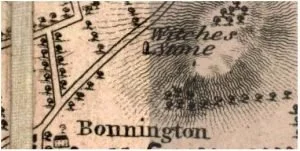
The Witches’ Stone was first documented in Kirkwood’s Environs of Edinburgh map in 1817 and was found amidst other cup-and-ring stones at Tormain (some of which still remain). Daniel Wilson then investigated further in 1851, stating the peculiar Witches’ Stone was a giant capstone of a cromlech (a single-chamber stone tomb) that once stood here, but whose structure had then crumbled. Wilson, after visiting Witches’ Stone, then rescinded his initial assessment, claiming he ‘altogether doubted if they are the remains of a cromlech’, but instead was probably just a very cool combination of environmental circumstances.
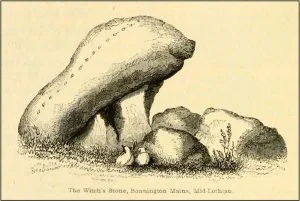
Wilson’s 1851 drawing of the Witches’ Stone
The stone boasts an impressive 22 cup marks, and Fred Coles described in 1903 that ‘thirteen follow each other from the high south edge of the stone for a distance of exactly 6 feet, and nine others lie a few inches to the west, occupying a space 3 feet long of the overcurving edge of the north end.’ Some speculate that the cup marks than run north probably held quite a bit of significance, and lends itself to the magic and mystery of folklore.
…in pre-christian religious structures across the northern hemisphere, north is commonly representative of death and the land of the gods. In magickal rites “it is the place of greatest symbolic darkness,” as neither sun nor moon ever rise or set there.
A legend had sprung from the Witches’ Stone (hence it’s name!) that it was used for healing by a local witch. Some, including Scottish occultist Michael Scot. J.R. Allen, have attributed the peculiar slope in the stone as part of fertility rituals: “the sloping face of the stone has been much polished by the practice of people climbing on to the top and sliding down”.
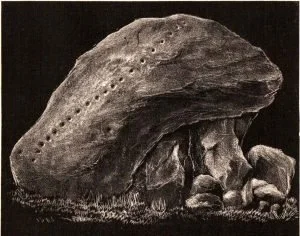
Simpson’s 1866 drawing of the Witches Stone
Witches’ Stone, regrettably, was blown up sometime between 1918 and 1920. I can’t find any reason as to why it might have been destroyed. Did it hold too much religious, or ritualistic, significance? Was it destroyed purposefully? Supposedly, the remnants of the stone are still piled up in the woods.