River Wear, Durham 1700s
“Whisht! lads, haad yor gobs, An’ aa’ll tell ye aall an aaful story,
Whisht! lads, haad yor gobs, An’ Aa’ll tel ye ‘boot the worm.”
Do you ever think to yourself, ‘hm, I wish there was a story about a giant worm with nine holes down the side of its head that would eventually go on to curse an entire bloodline just for being inconvenienced?’... you’re in luck! We’re travelling back to the 1700s for our tale but the legend of the Worm has been documented since the 1300s (old-ass worm!).
John Lambton is our hero (or villain, if you’re the worm). Born in 1792 to parents Lady Barbara Frances Villiers and William Henry Lambton, John found fortune at way too young an age after a family member’s passing and perhaps this tragedy is what gave him the foolish bravado that would come to be his downfall.
Full of vigour, and self-assurance (probably fuelled by the ungodly fortune he’d inherited), John would often cheekily skip his church service on Sundays to go and lollygag, dawdle and even perhaps dilly-dally in the local area. This particular fated Sunday, John fancied a spot of fishing, and so took himself over to the River Wear (under God’s disapproving eye).
Whilst setting up for what was surely going to be a marvellous spot of fishing, John was approached by an old withered man, who croakily warned him of the dangers of skipping church service. Exclaiming ‘no good can come from missing church, boy!’, John shrugged the man off - the fish were not going to catch themselves and God could wait a few hours, he’d been omnipresent for years, what harm would waiting one day do?
But try as he might, John didn’t get so much as a nibble from any aquatic friends until the bells indicated the end of the usual church service (so he could have attended, really...), but wait, what is this? A bite! Out of the murky waters John pulls what appears to be... a snake? An eel? No bigger than his thumb, a reptilian Salamander-esque head with nine holes down the sides.
John recoils, flinging his catch down into the spiralling depths of a nearby well, hoping to never set eyes on such a horrific specimen ever again. On his weary walk back, John bumps into the withered man once more, claiming he had ‘catched the devil", of which I’m certain the man was wearing his best ‘I told you so’ expression.
John grew up, as all of us do, and decided to ask God for forgiveness by joining the Crusades. As John is off living his life, avoiding rivers and crusading, the worm has not forgotten the betrayal of being dragged from its home and tossed so heartlessly into the dark murky depths of the well (I don’t think I would, either). The worm grows exponentially, driven probably by hatred and a will to escape the well (of which the worm has now poisoned, rightly so).
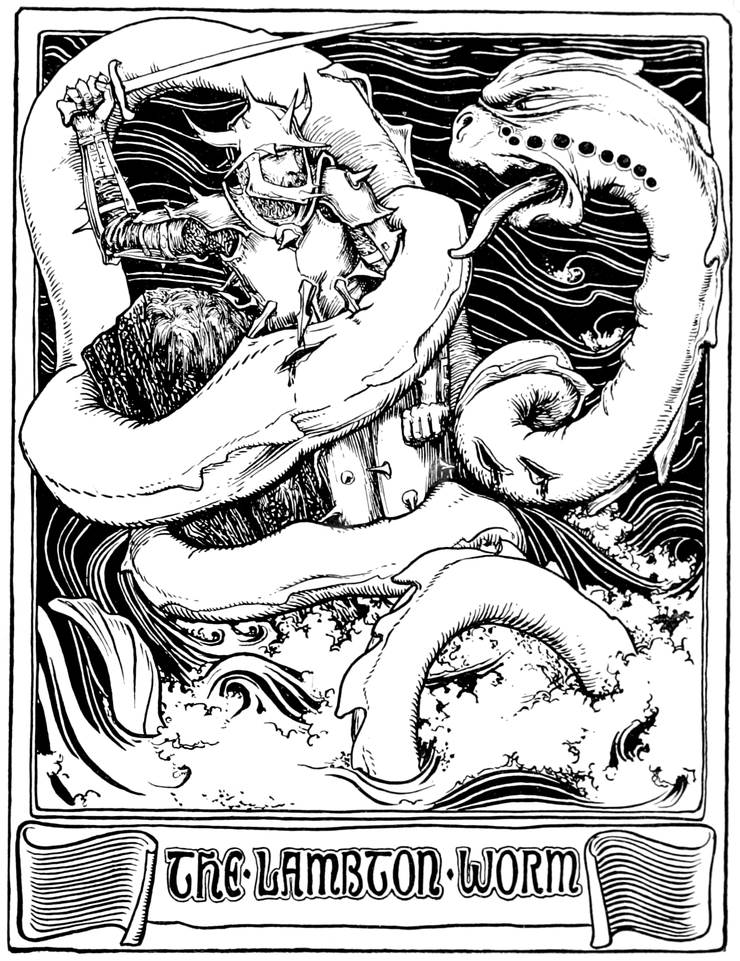
The townsfolk begin to notice strange happenings, missing and maimed livestock, a weird worm-like shape coiling around the nearby hill, large enough to have wrapped itself around six or seven times, just every day things. The worm is pissed, and begins its tirade of misery eating sheep, preventing cows from producing milk, and kidnapping local small children.
The worm, realising it could probably profit from this new life, decided to make its way to Lambton Castle, in which the Lord supposedly struck a deal with the worm to sedate it from it’s menacing ways by the offering of milk from nine of his good cows (a deal which would probably kill a lactose intolerant such as myself).
Do you remember being told that if you cut a worm in half, it will magically regrow it’s body? This doesn’t change for oversized worms, and try as the townsfolk did to chop this thing into pieces, the Lambton Worm kept growing its flesh back. Knights from neighbouring towns had a go, but the worm was not yet beaten.
After hearing of the worm’s return, and feeling possibly a tad guilty for bringing this destruction upon his home town because he was too lazy to attend church, John returned to finish the job. No battle is won without first consulting the local witch, and she advises him to cover his armour in spearheads and tackle the beast head on (perhaps she was mad at the calamity he had caused and was hoping for his death). She prophesised that John must first kill the worm and then kill the first living being whom approaches him or his bloodline will be cursed for nine generations to never die peacefully in bed.
A shocking revelation but John plucks up the courage to tackle this head, and spear-covered body, on. John asks for a hunting dog to be released upon the death of the worm, so John can kill the dog (boo!) and avoid the curse.
The battle was epic (probably, it’s a giant worm afterall) and John succeeded in chopping the pest into pieces with his spiky armour. Overjoyed by the news, John’s father failed to release the hound, instead gleefully sprinting over to his son to congratulate him (sweet in some ways, very foolish in others). John, mortified that his father was the first to approach him, refused to partake in the witch’s advice and did not kill his father.
As all superstitions go, the Lambton bloodline did befall tragedy. Robert Lambton, first generation, died of drowning. Sir William Lambton, second generation, was killed in battle. William Lambton, third generation, also died in battle (which makes sense, it was a very battle-heavy time period). The worm took a break for several years but came back to kill ninth generation Henry Lambton in a carriage accident. What luck!
Sources
https://www.thelambton.com/the-tale/
https://www.historic-uk.com/CultureUK/Lambton-Worm-Sir-John-Lambton/