Whalley, Clitheroe 1689
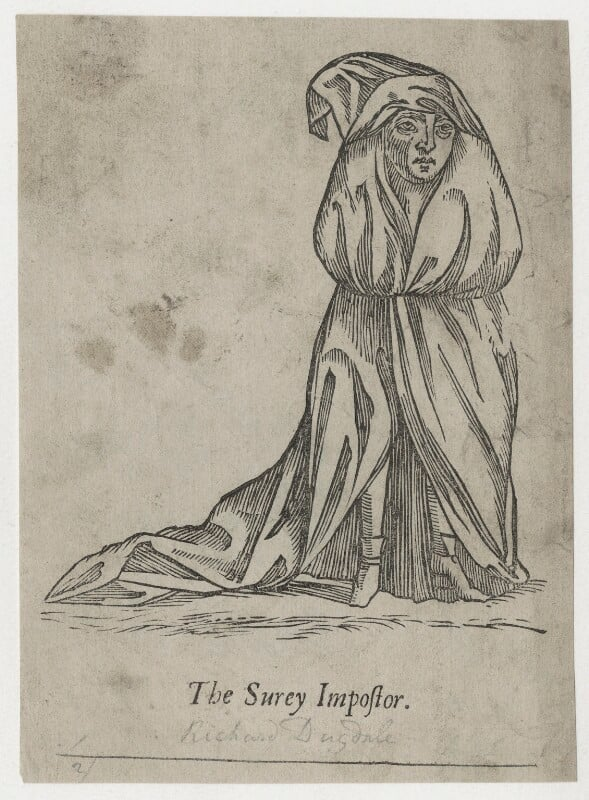
“Some few passages, which I took notice of all along from the first, as to the case of young Dugdale of Surey, near Whalley in Lancashire, aged about 19 or 20 years.”
Displayed in a glass cabinet, down in the dark depths of Burnley Library, sits a small slice of Lancashire history of the most ‘devlish’ infliction. Locked in the cabinet you will find ‘The Surey demoniack, or, an account of Satans strange and dreadful actings, in and about the body of Richard Dugdale of Surey, near Whalley in Lancashire’, admittedly not the catchiest title for a book but describes exactly what is in the folklore tin.
This bound pamphlet was published with contributions from six ministers but was written by minister Thomas Jolly and trainee minister John Carrington. And as the lengthy title suggests, it follows the peculiar accounts of the demonic possession of Richard Dugdale (or as he was compassionately nicknamed, ‘Dicky’) in the summer of 1689, near Whalley, Lancashire.
It’s July, Britain has entered what would be named the Glorious Revolution and is saying a great good-bye to King James II, but young Richard ‘Dicky’ Dugdale did not care a minute for such monarchal changes. Instead, he wanted to have a good time - don’t we all? Picture this, you’re at a Rush Bearing festival in the heart of the Lancashire countryside, perhaps ladies are present? Dicky, much like The Nolans in 1979, was in the mood for dancing and needed to ensure he did not make a fool of himself. Solution? Make a deal with the Devil, of course! And that’s exactly what Dicky claimed to have done.
And dance he did. Did he get into a scrap or two during a drunken disagreement? Sure, but don’t all 19-year-old lads lead a similar teenage hood, despite the time period? Probably not.
Dicky stumbled home after the Rush Bearing frivolities and began to feel strange... his body started spasming and contorting in all different directions, his skin felt as if it has been licked by flames as an intense burning pain spread across his side. Just when Dicky thought things couldn’t get worse, ghostly apparitions begun appearing to him in the dead of night (eat your heart out Charles Dickens).
It was when a table full of golden treasure appeared to him, with a voice tempting him to take all he wanted, when Dicky and his family called upon Dr Crabtree and Dr Crew. Our esteemed bound pamphlet nestled in the basement of Burnley Library claims that Dr. Crabtree and Dr. Crew were of no help, but as this lead to the hiring of the ministers writing the book, could we perhaps accuse them of bias? Dubious...
Being dismissed by science, the family turned to religion. Richard was brought to the farmhouse of Thomas Jolly at Wymondhouses, Pendleton, under the looming presence of Pendle Hill. Jolly made the obvious (duh?!) conclusion that Dicky had been possessed by the Devil, nothing else could possibly be causing his ailments, certainly nothing curable by any respected doctor.
“As I began to read the Lord's prayer, Dugdale began to seize. His motions during the fit were very strange, the whites of his eyes became the only part visible rendering the poor boy stark blind – all whilst his eyelids remained open.”
Whilst Dicky was busy cosplaying The Undertaker, Jolly noticed that the boy had become preternaturally strong, ‘a strength beyond his natural ability and agility’. A rage so furious fell over him as Jolly mentioned Christ in the Lord’s Prayer, a rage only equalled by those experiencing their sock slipping off inside their shoe.
Defeated, but not undeterred, the ministers gathered almost weekly to read the Lord’s prayer at the writhing and angry Dicky. The barn in which this took place was mostly ‘The Surey’, which most believe to have been rented by Dicky’s family (lucky them!), it is said this was in or around Whalley Abbey.
Getting no where with prayer, the ministers called upon fresh, young buck John Carrington, because we all know that the solution to this is to add more ministers to the mix of already saturated religious presence. Dicky, or Mr.Lucifer living inside him, did not like Carrington one bit. He raged more violently in Carrington’s company, spitting “Oh Carrington, I hate thee mortally, Oh I’ll be revenged on thee”, which is a tad dramatic, even for a demonic entity.
You thought that demonic possession would be the worst part of this sordid tale? No. People, crowds and crowds of people, gathered at each exorcism to gawk at poor Dicky, like a malnourished panda in a too-small cage. They jeered, and cheered, and sometimes feared. Did the respectful ministers shoo the crowds away to get on with their extremely, life-saving, important work? Absolutely not, this was great publicity for the powers of Christ!
“When I get thee to Hell I will make thee my porter to carry damned wretches from one bed of flames to another”
Is that a line from a Shakespearean play? Nope, just Dicky being extremely unreasonable towards Carrington. Dicky then went on to list people in Carrington’s live who had passed away, claiming them all to be burning in the damnation of Hell - a bold claim.
After months of prayers, Carrington roasting and crowd participation, Dicky was still afflicted with the demonic presence. People claimed to see him dance around the room, hopping similarly to a frog. 22nd October rolled by, a day in which the demon residing in Dicky predicted that the boy would be carried to Hell by Satan. The crowd was on tenterhooks, if popcorn had been invented in 1689 the crowd would have surely been munching by the bucketful.
Did the ground open up and swallow Dicky whole? Definitely not. Things were looking up for the repairing of Dicky and Carrington’s tense relationship, as Dicky offered the trainee minister a large apple for his troubles (awwww). Carrington saved his fruity treat for his horse-ride home, upon which he noticed a hole forming at the base of the apple and something inside appeared to ‘bubble and flash’. He should have known better than to expect his relationship with Dicky to be resolved with one piece of fruit.
Carrington buried the apple underneath a large stone to save anyone else the embarrassment of seeing such a horrendous food. After being (rightfully) confronted, Dicky claimed to not know a thing about the bubbly and flashy piece of fruit. Dicky did mention, bizarrely, that a 14-pound stone had been placed on his chest the very moment Carrington buried his apple.
During this very public period in Dicky’s life, gossip had begun to spread about the legitimacy of his case. The very same eager-eyed members of his audience began claiming that Dicky’s family were tricksters and known to dabble in witchcraft. These claims led no where, as do most claims from nosey neighbours and curious passer-bys.
On March 24th the following year, Richard Dugdale seemed to have one last hurrah, a tremendous fit in which his demon voice pronounced “now Dicky I must leave thee, and must afflict thee no more as I have done, I have troubled thee thus long by Obsessions, and also by a Combination, that never shall be discovered as long as the world endures.” Which to me seems like a dramatic and long-winded way of saying ‘alright, it’s been real, but you’re kind of boring me now’. Was the demon ever seen in Clitheroe again? Who knows…
Sources
The Surey demoniack, or, An account of Satans strange and dreadful actings, in and about the body of Richard Dugdale of Surey, near Whalley in Lancashire and how he was dispossest by Gods blessing on the fastings and prayers of divers ministers and people ...", Jollie, Thomas, 1629-1703. London :: Printed for Jonathan Robinson, 1697.
https://lancashirepast.com/2024/12/28/a-history-of-the-surey-demoniack-whalley/