Midgley Moor, Calderdale 1600s
“Farmers brought their milk this far, and cottegers
From the top of Luddenden valley left cash
In the stones crown, probably in vinegar,
And the farmers left their change. Relic of The Plague.”
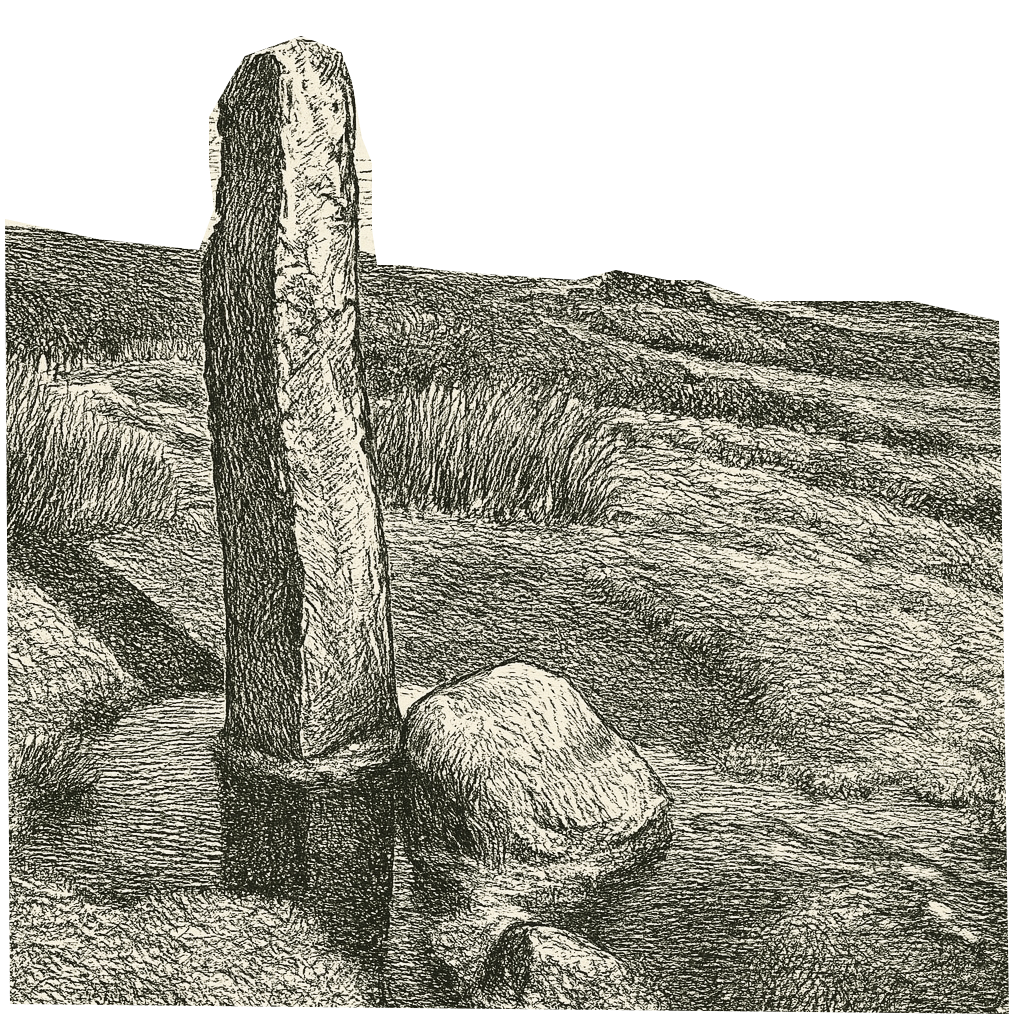
A 7ft stone presence, lurking in the fields of Midgley Moor, with a curious name. A devilish bargain, an anthropomorphised rock, an old Plague custom, a moorland ghost, killer foxes... no that is not a list of my Saturday evening plans, these are the theories of how this stone gained the name Churn Milk Joan.
Our stone in question sits quietly and unassuming in Yorkshire, a county renowned for its rich folklore stories, so it’s no wonder tales and speculation gathered starting in the 17th Century on the origins of this dairy-themed stone. Erected originally in the 1600s as a boundary stone, a local farmer’s loss would be the catalyst for the renaming of the stone.
Joan, the daughter of a farmer (as I’m sure most daughters were in the 1600s), set off on her long and lonesome journey over the Wuthering Heights-esque stretch of Midgley Moor to deliver her churn filled with milk to the neighbouring villages. One tale, from origins unknown as is the magic of folklore, speaks that on that fated snowy evening, Joan was approached by the Devil.
He hissed that he was travelling over to take the souls of her parents, and Joan protested, instead offering her soul in exchange for her parents’ lives. Sounding like a delectable deal for the demon, he agreed, and the next morning Joan’s limp, lifeless body was found frozen at the base of the stone, her once fresh milk now spilled from its churn, frozen in place.
Local celebrity Ted Hughes questioned the validity of this tale in the form of a poem, as you’d expect from a poet, stating ‘A lonely stone, Afloat in the stone heavings of emptiness, Keeps telling her tale. Foxes killed her.’ And as sweet as this sounds in prose, Hughes was basically telling everyone to get a grip, it was clearly rabid, killer foxes who ended Joan’s journey, stop this mad talk about the Devil.
Rather distastefully towards poor Joan and her family, a monument depicting Hughes’ opinion on the matter was erected in Mytholmroyd. A milk churn with two adorable, cartoonish foxes surrounding it paints the story in a rather jovial light. If this was in fact the deathly fate of our protagonist, I rather imagine the scene to include way more blood and way hungrier, angrier and quite frankly Lovecraftian foxes standing over a gore-inflicted body.
There have, of course, been stories from non-believers of the occult claiming that Joan probably tripped and fell, and due to the blizzard of snow falling on that particular evening, failed to carry herself back home and subsequently froze to death. But we say nay, give us more mystery and intrigue than that!
Despite the unknown origins of the name, the stone itself has some supernatural legacy surrounding it; tales of the inexplicable. It has been reported that the 7ft stationary stone turns three times as the bells of midnight strike and echo through the valleys from Mytholmroyd church on New Year’s Eve - signalling the turn of the new year. Would I want to be up on the isolated Yorkshire moors in the heart of winter to see this for myself? Would I heck.
But the mysteries of Churn Milk Joan do not end at physical movement, a small hollow at the top of the stone has, over the years, become home to coins from weary travellers. Legend has it that one should take a coin from Joan and replace the coin with a new coin, one of your own I guess... although I suppose if you’re into stealing you could give one of someone else’s coins.
Some say this tradition dates back to the Plague, in which the hollow would be filled with vinegar and those passing through villages could disinfect their coins before exchanging with traders. Hughes himself alluded to this in his aforementioned poem, ‘In the stones crown, probably in vinegar, And the farmers left their change. Relic of The Plague.’ Did Hughes cough up some coins for Joan?
Some historians have debunked this theory, claiming that the stone may be a little too tall to be a convenient place to wash your coins. Given that people were generally a lot shorter in ye olde times, a 7ft hunk of stone may have been a little unrealistic for our travelling friends.
In this case, could the coins presented to the stone be a more precautionary feature? If Joan did die beside the stone, either by the Devil, rabid foxes or from being, well, a little too cold, it may not be too far fetched to believe her ghost has stuck around. The next time I visit Churn Milk Joan, I’d be inclined to offer up some coins just to keep any potential hauntings to a minimum...
So let us remember Joan, if this was indeed the place of her death, may your milk stay cold and your hearts remain warm. Do you believe the tales of the Devil? Was it foxes that caused this, or was it simply just a boundary stone? Let us know!
Sources
https://paulweatherhead.com/2024/06/30/churn-milk-joan-lonely-stone-tells-her-tales/
Churn-Milk Joan (1979). Ted Hughes from Remains of Elmet.
https://www.thenorthernantiquarian.org/2010/09/06/churn-milk-joan/
https://www.colingreenphotography.co.uk/2021/04/churn-milk-joan-midgley.html