Artist Highlight: Ruby Waage Townsend
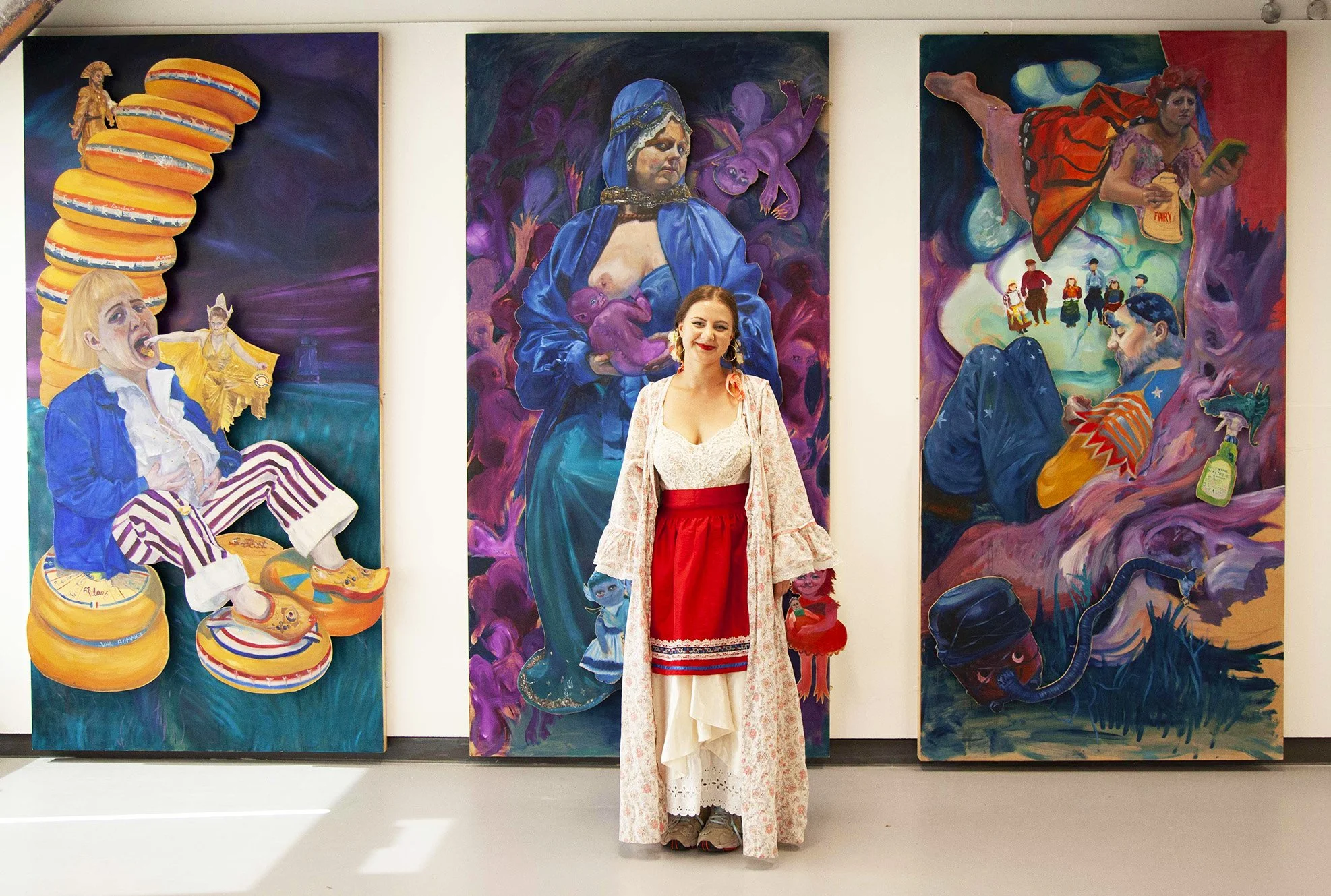
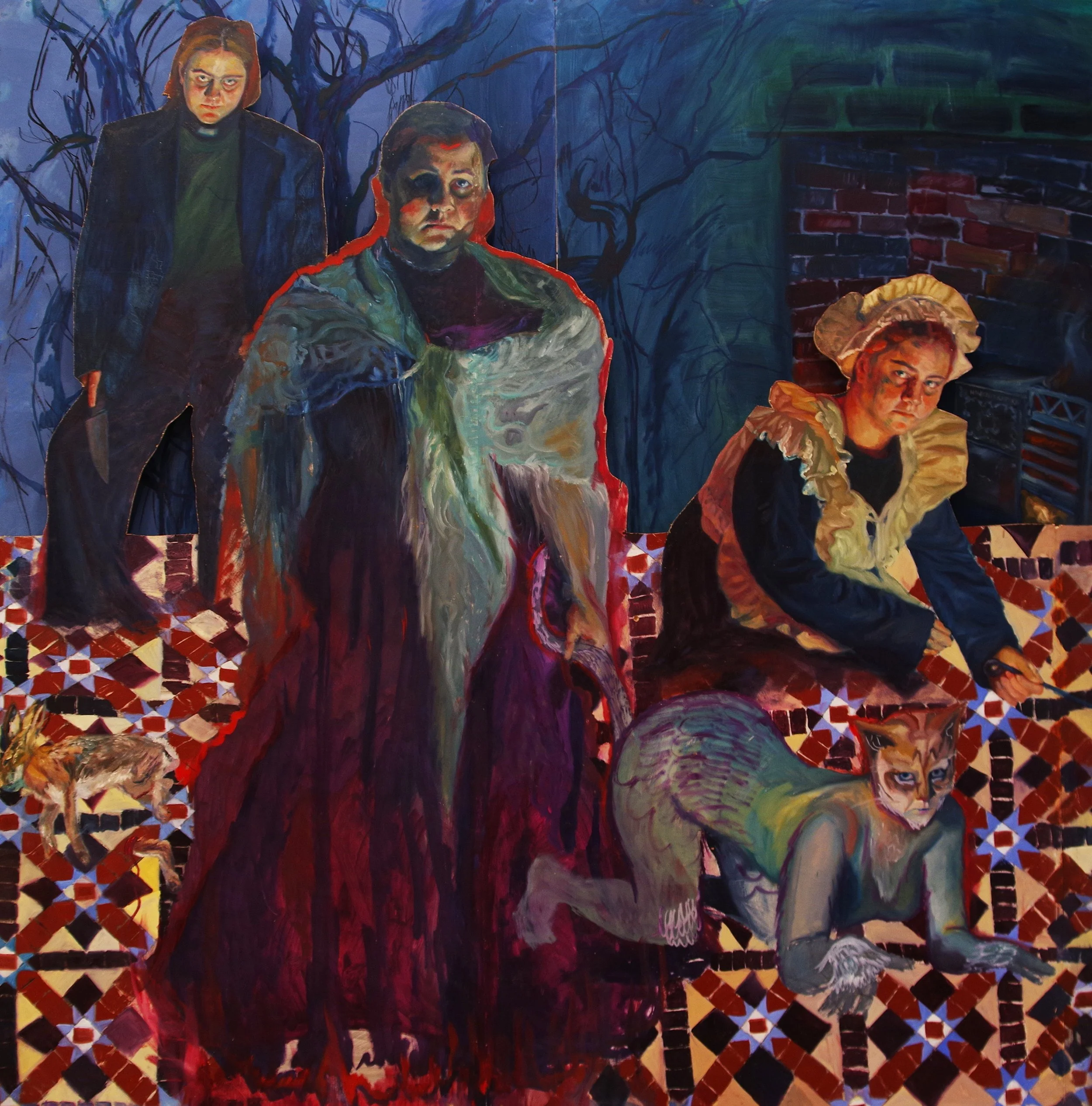
Working across figurative oil painting, performance and immersive world-building and drawing inspiration from folklore, feminism and working class storytelling, Ruby is a U.K. based artist. They explore myths and their inheritance and how stories can be used to heal but equally wound. Ruby is currently studying an MFA at the Slade School of Fine Art.
We had the delight of chatting to Ruby about creative projects as a form of self-expression, reconnecting to oneself during modern times and how folklore could help people navigate difficult times.
Northern Folklore Archive: Do you find that artwork is a good medium for expression? Do you feel that your creative projects are the best form of self-expression for you?
I think artwork is such an integral way of being for everyone. We are all artists in some way, through the way we talk, make food, dress, write, or care for one another. For me personally, making art has been fundamental to my survival. As my work addresses complex subjects such as trauma, neurodiversity, class, and feminism, art becomes my outlet, my voice, and my grounding tool.
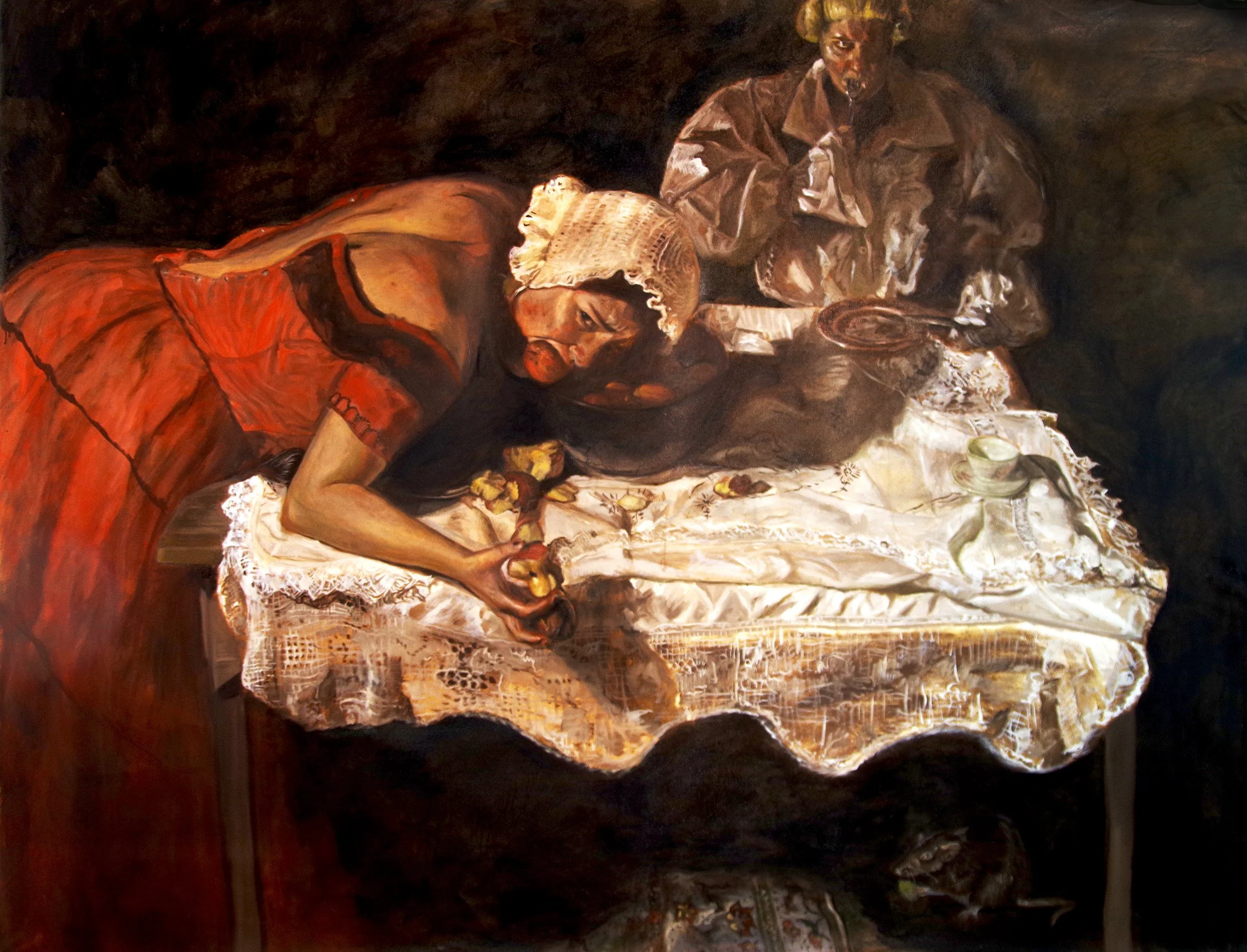
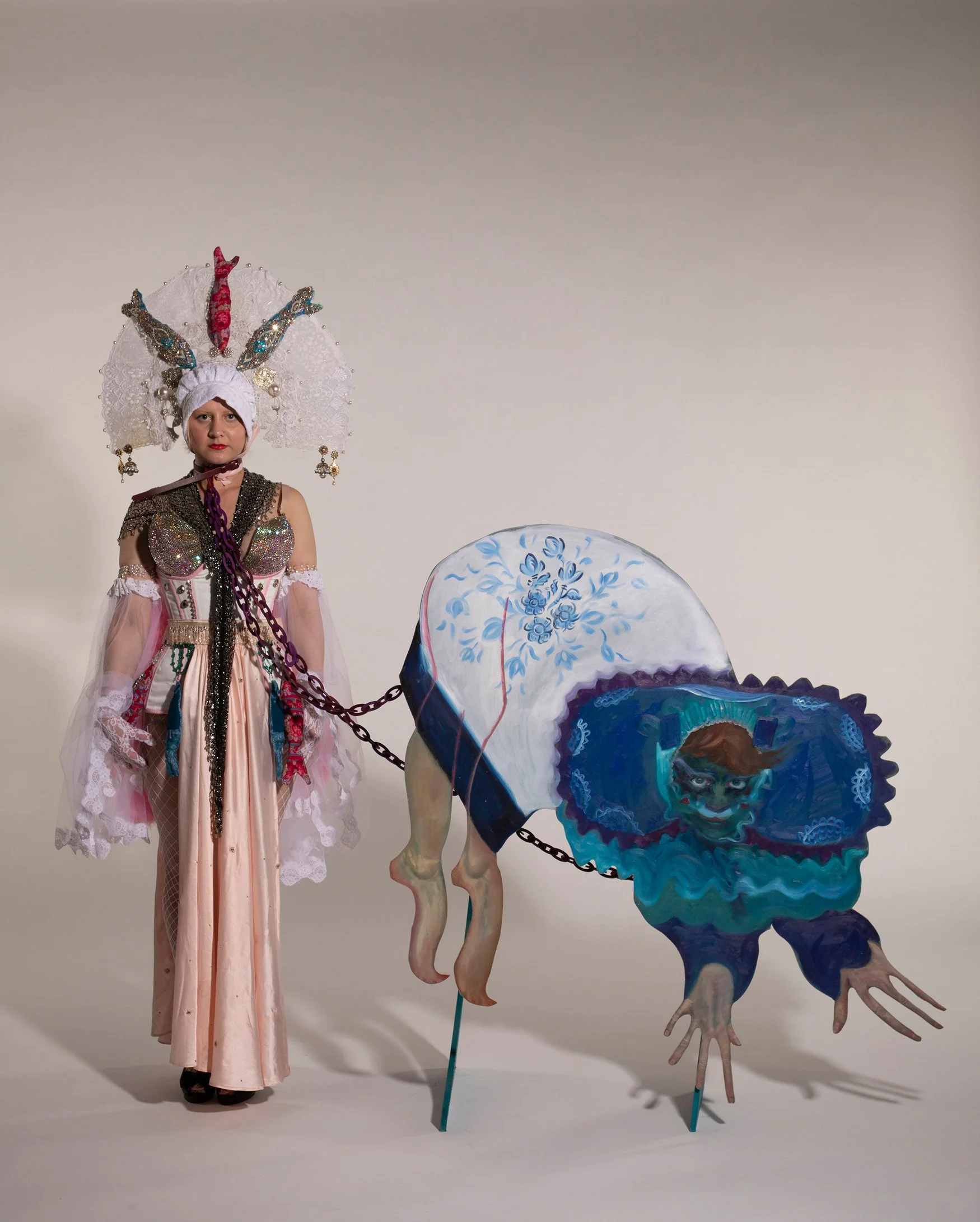
Costume is also a very important element of my practice. I initially expressed myself through taking on different roles and transforming, particularly when I worked in a gorgeous vintage shop in Leicester. I’ve always lived in a dressing-up box. This act of becoming really centres my practice. I see painting as a culmination of these enacted psychodramas, in which I inhabit multiple roles across mythology, folklore, and imagined worlds.
You work in many different disciplines. Do hands on creative projects help you reconnect and recentre yourself in modern life?
100 per cent. I’m often like an elastic band, quite impulsive (thanks, ADHD!), and painting gives that energy somewhere to go. It combines my need to move and create with deep focus, making the world go quiet as I zone in and find presence, away from my whirring mind and into the act of painting.
World-building helps me make sense of my experiences and create alternative realities where justice, care, and complexity can exist. In the paint, I can hold a whole kaleidoscope of emotion, grief, joy, whimsy, anger, love, rebellion, and release.
I’m very much an analogue person, and the physical act of painting, watching colours transform on the palette, allowing for accident and play, helps me find slowness and stillness in a hectic world.
Your research specialises in folklore and its connection to psychology. With folklore becoming popular again, do you hope it helps people navigate difficult times?
I do. I’m a huge admirer of Lucy Wright’s thinking around folklore, particularly her belief that folklore belongs to the people who carry it. Folklore is inherently communal and political. It reflects how power, class, gender, and morality are understood and passed down, often quietly, across generations.
I’m also deeply inspired by writers like Clarissa Pinkola Estés, who acknowledge folklore’s complex history, especially how many stories were originally shaped by women and working-class communities before being altered through writing to serve colonial and patriarchal values. By returning to folklore with honesty, to the oral tradition, we can begin to reclaim it as something inclusive and alive, uncontrollable, a shared language for questioning the systems that shape our lives.
As a survivor of gender based violence, I use folklore not as an escape, but as a way to challenge harmful norms and imagine alternatives. These stories allow us to speak about fear, survival, care, and resistance in ways that feel accessible and collective. In difficult times, folklore reminds us that change has always begun at the level of shared stories.
What is it about folklore that inspires your creative projects?
Folklore gives me a framework to explore power, class, and feminism without flattening complexity. It's clear that archetypes of good and evil allow space to question how those roles are constructed, who gets cast within them, and who is excluded altogether.
In my paintings, which often take the form of large pop-up books, I inhabit multiple roles at once through self-portraiture. This allows certainty to loosen and contradiction to exist. I’m interested in how folklore shapes our earliest understanding of home, danger, love, and belonging, and how those narratives influence the psyche and our views of the world.
Because folklore is oral and evolving, it has the potential to change. Stories can be retold, revised, and reclaimed. I’m particularly drawn to regional folklore and lost histories, including those connected to my Dutch heritage, as a way to reconnect fragmented identities and imagine fairer futures grounded in care, agency, and collective responsibility.
Lastly (and I'm asking this to everyone) one of the Northern Folklore Duo is a huge film fan, so this question is purely for him... what is your favourite film?!
A very good question! It has to be Labyrinth by Jim Henson. It’s always been a comfort film for me, and I love the artistry of it, but recently I’ve been reflecting on why it still resonates so deeply.
I think it’s the sense of performance, performative domesticity, and shifting power dynamics. When I was little, I wanted to run away with the goblins. Now I’m especially drawn to the moments where illusion breaks, the masquerade scene, and where Jennifer's constructed bedroom falls away. Those moments inspire me deeply. Sometimes I listen to the soundtrack while I paint!
It was so nice to chat to Ruby, explore how she uses folklore for her creative work and how folklore itself has helped on a more personal level. If you’d like to keep up with Ruby’s work, you can follow her on Instagram @rubywaagetownsend and you can find her over on her website rubywaagetownsend.com
Community Categories
Quick click to another article from the categories below.
- Artist
- Printmaker
- Cornwall
- Folk Music
- Folk Workshops
- Foraging
- Foraging Folklore
- zoe eliza
- Folklore Art
- Emily Wild
- Interview
- Blood Stone Books
- Folklorist
- Pickled Pennies Prints
- Musician
- Craig Hallam
- Wycombe
- Morgana Weeks
- Poet
- Plantlore
- Corn Dollies
- Linocut
- YouTube
- Vic Jay Art
- Ros Lorimer
- Linocut Printer
- Illustrator
- Sasha Spyrou
- Author
- Wyrd Wycombe
- Minifis Oddities
- Stevyn Colgan
- Emma Kathryn
- Filmmaker
- Scared in the Name of Science
- Liza Frank
- Ciara Armstrong
- artist
- elisabeth flett
- Events
- Folklore
- Historian
- North East Folklore Society
- Witch
- Folklore Agony Aunt
- musician
- Will Matthews
- HerOrangeCoat
- Wabi Sabi Creations
- Podcast
- kirsty greenwood
- Publisher
- Nikki Bell
- Another Realm
- folk music
- North East
- Devon
- Kym Deyn
- writer
- Writer
- illustrator