Westhoughton ‘Cow Heads’
Westhoughton, Greater Manchester 1800s
“We are proud that poets and performers preserve the Keaw Yed Legend, Lancashire dialect and local traditions.” Westhoughton Town Council
I found out about this charming little folklore tale the way that all folklore tales should be heard, I met a lovely man named Adam (@adcro on TikTok & @itsadcro on Instagram!) whilst trading at the Bolton Makers Market. He was such a delightful person to speak to, and he let me know about the Cow Heads of Westhoughton.
Westhoughton is a town 2 miles south west of Bolton and 12 miles from Manchester. It’s name is derived from Old English (as many town names are!), ‘halh’ (pronounced ‘haugh’) for a nook or corner of land. ‘Tun’ for a farmstead or settlement, so a ‘westerly settlement in a corner of land’. Recorded historically as Halcton in 1210, Westhalcton in 1240, Westhalghton in 1292, Westhalton in 1302 and finally in the 16th century as Westhaughton or Westhoughton.
So where on Earth does ‘Cow Heads’ come from?! There’s a few explanations, but I know which one amuses me the most…
The locals of Westhoughton are referred to (by themselves, no less) as ‘Howfeners’ or ‘Keawyeds’ (this being Lancashire dialect for Cow Heads), or sometimes an amalgamation of the two ‘Keawyedners’, with the town often being called ‘Keawyed City’.
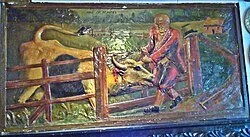
According to local legend (our favourite phrase when talking about folklore!), a farmer from Westhoughton was counting his cows when he realised one was missing. He searched high and low, and eventually stumbled upon his cow, head trapped firmly betwixt a five-bar gate. What a dilemma he found himself in! One of his cows in peril, trapped, unable to free itself. His amazingly structured, gorgeous, prized gate caught in a mess of cow. What would he do?!
Well, you might think that he’d simply cut around the cow, into the gate, and free the animal so that it can return to its cow friends and continue to provide for the farm. WRONG! The farmer weighed up the pros and cons and decided that he’d lose more money replacing the gate than replacing the cow… and so he swiftly chopped the head off the cow to save his beautiful gate.
There are other theories as to why Cow Heads has been adopted by the locals, of course. We couldn’t just accept folklore as an answer, now, could we?
Supposedly, the term ‘Keaw Yed’ refers back to the town’s history in the Cotton Industry. Before the advent of cotton weaving mills and machinery, Westhoughton was home to hand weavers. A weaver holding a large roll of cloth across their shoulders used to give the silhouette of a cows head, if one was to look from a distance, making it seem like Westhoughton was full of human/cow hybrids.
But ah! There’s more! Another theory is that Saint Bartholomew, to which the Parish Church of Westhoughton is dedicated, was the patron Saint of Tanners. There are four cow heads engraved on the belfry of The Parish Church of St. Bartholomew, indicating that perhaps the Keaw Yed nickname originates from this beloved Saint.
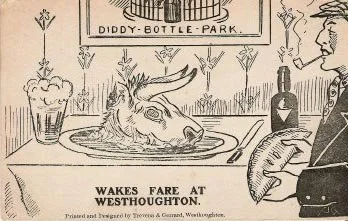
MORE?! Back in 1815, to celebrate the victory of the Battle of Waterloo, a mock battle took place in Westhoughton between people of Daisy Hill (a village south of Westhoughton) and those from the Town Centre. An Ox was roasted for this occasion, and those who won the mock battle would be presented with the head of the Ox as a prize… The losers then dubbed the victors ‘Keaw Yeds’, or Cow Heads, as a petty taunt. Sore losers, indeed.
After chatting to Adam about this wonderous tale, my partner in Folklore looked up Westhoughton and found out this was the birthplace of Robert Shaw. So, of course, I had to write this up for the Archive… because now he wants to visit!