Cuerdley, Warrington 500 AD - 1000 AD (?)
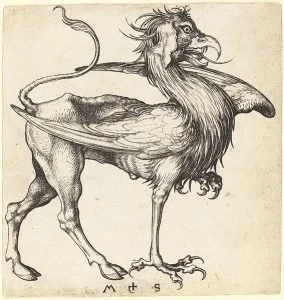
“Some versions of the legends call it a Dragon, but most agree that it was a Griffin – a carnivorous monster with the head and wings of an eagle and the body of a lion.”
Fiddler’s Ferry Power Station, named after a local inn, sits on the site where once lived an old ferrying service responsible for taking passengers across the River Mersey. But this area holds even older myths and legends, including one of a Blacksmith and a Griffin…
This tale has been passed down from generation to generation, told many-a time over campfire, and whispered on the playground, and originates from sometime during the Dark Ages (a long, long time ago!). Robert Byrch, a blacksmith whose forge stood in Cuerdley, Warrington (where the power station is today), owned a prize ox. He loved his ox so much that he would let it graze on the nice grass, the good grass, near the other cattle owned by the villagers of Farnworth.
A rocky outcrop sat near this delicious marsh of good grass, which was home to a horrible beast. A creature that many daren’t even speak of. ‘A carnivorous monster with the head and wings of an eagle and the body of a lion’, townsfolk would sometimes spot it flying overhead, scoping out its next meal. It would often choose to swoop down low over the marsh to pick up unsuspecting cattle before flying back to its lair in the outcrop.
As the Griffin got hungrier, it’s appearances in the sky grew. At first, Robert got lucky as the Griffin would avoid the harsh flames of his forge and leave the prize ox alone, but it’s hunger grew and it had wiped out the other cattle nearby… it was time for the Griffin to attack Robert’s prize ox. Noooooooo! Robert had to do something to put an end to the Griffin’s reign of terror and so devised a cunning plan.
Being a blacksmith, he was able to forge a sturdy iron cage, large enough to fit Robert inside with a few supplies and an epic double-edged sword. He ordered the villagers to hide their remaining cattle away, somewhere far from the Griffin, and hunkered down inside the cage, covering it in animal hide. The Griffin left it’s lair once more to feed, and with all other cattle hiding away, the animal hide made a delicious looking snack to the idiot Griffin.
The Griffin, full of audacity, swooped down to grab it’s treat and sunk it’s claws into the iron cage underneath the cow hide. Pranked! It clung on, however, and lifted it high up into the sky with a few wafts of it’s enormous wings… with poor Robert cowering inside. Seizing his chance, however, Robert boldly thrust the sword through the gaps in the cage and into the Griffin’s exposed stomach. Huzzah! But wait, the Griffin loosened it’s grip on the cage, probably from the pain of being stabbed, and Robert quickly realised his mistake. He was 200ft up in the air, of course, and he’d just stabbed the only thing keeping him from falling to his death.
Desperately, Robert thrust his arms through the cage and tried to pull together the wound he’d created on the Griffin’s stomach, praying it would keep the Griffin together long enough for them to safely land. Some versions of the legend say the beast and Robert landed near Halton Hill (where Halton Castle now stands), whilst some claim that the Griffin’s lair was actually a promontory that people now call Rocksavage.
As the Griffin landed, keeping Robert safely in the cage… Robert thanked it by plunging the sword back into it’s belly… and then cutting off it’s head. Charming. He returned to Cuerdley with the beast’s head in tow and was met with an eruption of applause and congratulations. His bravery had spread, and news reached the King of the area at the time who issued a decree stating that Robert would be known from now on as ‘Robert the Bold’.
He also gave Robert as much land as he desired, and this area is now known as Bold, the civil parish in St. Helens. Some tell this tale to explain away the naming of this parish, giving it a fancy bit of lore. No actual historic records exist naming a ‘Robert the Bold’, but both the Bold family and the Barons of Halton use a Griffin as their coat of arms.
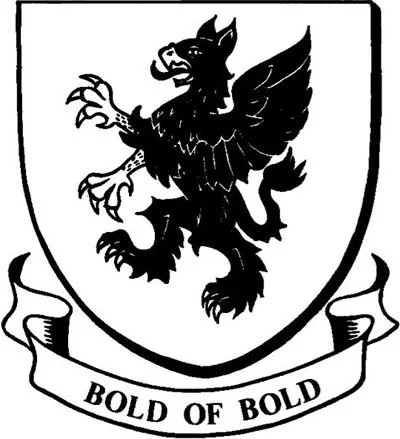
But wait, there’s more! By the 19th century, the Bold Family had lost their wealth, and last remaining member of the family, Henry Bold-Hoghton, sold the Bold estates in 1858 and formally removed the ‘Bold’ part of their name. The last piece of wealth the family had was a pew at St. Luke’s Church in Farnworth, and after years of abandonment in the 1870s, the canopy of the pew collapsed… revealing something rather peculiar. The untanned hide of a cow, with curious claw-like marks all over its surface… Take from that what you will…
Ancient legends, as old as this one, obviously will have been altered and changed throughout time, like town gossip usually does, but it astounds me that these stories can last this long. I feel proud to be ensuring this story continues to be read and enjoyed by many.