Pendle, Lancashire 1612
“With the Arraingement and Triall of nineteene notorious witches, at the Assizes and generall Gaole deliuerie, holden at the Castle of Lancaster upon Munday the seuenteenth of August last, 1612.”
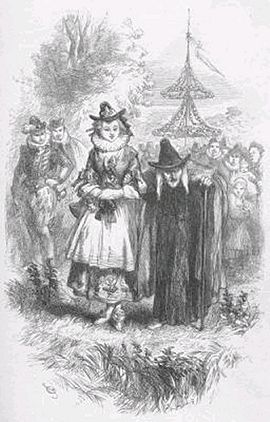
What would a folklore archive be without the tale of the Pendle witches? We joke and we have a good time at Northern Folklore Archive, but we mustn’t forget some of the horrors that come with these stories. Whilst it’s still up for debate whether witchcraft is real, the atrocities that women faced when witchcraft was a crime must be remembered.
To preface the story of those prosecuted in 1612, we must look at the context of the times. The country was under the rule of James the First, totally indoctrinated to resent Catholicism, James decided to pen the book Daemonologie in which he details that witchcraft is high treason and even children would be held in court if caught practicing. Lancashire in 1612 was still in the wake of the Gunpowder Plot, leaving James rather paranoid... which I’m sure only spurred his witchcraft hatred on.
Witchfinders were James’ number one crew to seek out ‘cunning women’ who he thought were conspiring against him, and these gangs were made up of magistrates and investigators. All of which were men I’m sure, and all of which probably hated women in the first place.
Context over with, let’s go back to the start of the Pendle Witch ordeal. Elizabeth Southerns, known as Demdike (I shall refer to her as such) had a daughter named Elizabeth Device who then had a daughter called Alizon Device. Alizon was travelling over to Trawden Forest one day and encountered John Law, a pedlar from Halifax. Alizon asked John if he had any pins he could spare.
Metal pins were something of a luxury in the 1600s, but were often regarded as important ‘ingredients’ for magic. John was already suspicious of Alizon for this reason, why would a woman need metal pins if not for performing magic? John refused to sell to Alizon and mere moments after their interaction, John fell to the ground. It is said to have been a stroke, once John regained consciousness and pulled himself to the nearest inn. Alizon, so fearful from James the First’s insistence that cunning women could be witches, believed she had cursed John (accidentally, she had no clue she had such powers!).
Alizon visited John’s bedside and begged for forgiveness, supposedly confessing that she had gotten angry and cursed him for not selling her pins. This confession sparked an investigation on the entire family. After probing, mainly done by Roger Nowell of Read Hall (the JP for Pendle known for seeking out religious nonconformists), it had come to light that the accused, her family and some other ‘cunning women’ had met at Malkin Tower, the home of the Demdikes, organised by Elizabeth Device (Alizon’s mother) on Good Friday - 10th April 1612. James Device (Alizon’s brother) stole a neighbour's sheep to feast on during this meeting... which isn’t witchcraft but certainly is a crime.
Once Nowell caught wind of this ‘party’, he consulted with Nicholas Bannister (another magistrate) to determine the reason for this meeting... could it be to discuss witchcraft and oppose their faithful overlord James the First?! Obviously! Elizabeth Device, James Device, Alice Nutter, Katherine Hewitt, John Bulcock, Jane Bulcock, Alice Grey and Jennet Preston were named as the attendees.
All attendees were sent to Lancaster Gaol to join others accused of witchcraft: Isabel Robey from Windle (accused of causing sickness to others), Margaret Pearson from Padiham (this was her third witchcraft trial!) and the Samlesbury witches – Jane Southworth, Jennet Brierley, and Ellen Brierley. Jennet Preston, however, was sent over to York as she lived in neighbouring county Yorkshire.
Nine-year old Jennet was the one that pointed the finger at the group and supposedly the one who ratted on them to Nowell. During the fated trial, Jennet was placed upon a table where she boldly accused the entire party of witchcraft, exclaiming damning conversations she heard between her own mother and their dog ‘familiar’. Once Jennet started, she couldn’t seem to stop. She claimed to have heard them reciting spells and implicated her entire family in one fell swoop.
But Jennet was facing trial herself over at York for the murder by witchcraft of a local landowner; Thomas Lister of Westby Hall. The majority of those in trial did not escape their fates, Jennet was found guilty and sentenced to death by hanging on 29th July 1612. Alizon Device, Elizabeth Device, James Device, Anne Whittle, Anne Redferne, Alice Nutter, Katherine Hewitt, John Bulcock and Jane Bulcock were found guilty and hanged at Gallows Hill in Lancaster on 20th August 1612. Elizabeth ‘Demdike’ died while awaiting trial and only one of the accused, Alice Grey, was found not guilty.
It seems strange to us now that these horrendous acts of injustice would take place, but if you remember that these events took place a century before the discovery of oxygen it seems less weird that they would be such mass hysteria over the idea of witchcraft. The general opinions of the population were so heavily swayed by the opinions held by monarchs, and so James the First’s fresh paranoia following the Gunpowder Plot, with many of Guy Fawkes’ accomplices still roaming the country, combined with his indoctrination against religions that weren’t his own and his hysterical ravings in his book Daemonologie... it’s no wonder these atrocities were allowed to take place.
Sources
https://cstuarthardwick.com/2019/06/08/the-sad-and-accurate-history-of-alice-nutter-catholic/
https://en.wikipedia.org/wiki/Pendle_witches
https://themorbidtourist.com/pendle-hill-witches/
https://pssauk.org/woman/alice-nutter/