Joan Jurdie
Rossington, Doncaster 1605
“From the moment of her entry into the house Mirfin’s wife ceased to continue the favourable progress she had been making, and so the suspicion that witchcraft was in their midst became verified.” - Evening Star, 1 November 1900
I think it’s about time we talk about more witches. As we know, in the 1600s witches were a very hot topic, with James I of England introducing An Act against Conjuration, Witchcraft and dealing with evil and wicked spirits almost as soon as he inherited the throne. This legislation meant not only was it illegal to cause death or injury by witchcraft, it was now a criminal act to just exist as a witch.
But we know all this, who is Joan Jurdie?! Let’s have a tiny, pit-stop of context of witchcraft in Doncaster itself, what did that look like? Two 17th century witch trials are recorded from the Doncaster area in the journal of Abraham de la Pryme, a clergyman from the Doncaster area, called the Yorkshire Antiquary. Born in 1671, he wrote about his life in the late 1680s and whilst these witch trials occurred before his birth, he was such a fan of local history and the occult that he made sure to mention them.
Jane Blomeley was one of the witches taken to trial in Doncaster, but we will revisit her at another time. We’re looking at Joan Jurdie today! According to De La Pryme, Joan was tried twice for witchcraft, once in 1605 and then again in 1608. The story begins with Joan Jurdie being invited to attend the birthing of the first child of Peter and Jennet Mirfin, way back in November 1604…
Joan decided not to attend, despite her reputation for being a whizz in medicine. When she did show her face, 3 or 4 days after the birth of the child, a small fight took place. Joan refused to enter their house, accept a drink or a portion of the ‘labour cake’ set aside for her. Her reason being that Peter Mirfin had once refused to enter her house or accept a drink from her. A perfectly valid response, I think.
Unfortunate timing for Joan, Jennet and the new born fell sick a few days after this altercation and had passed away by mid-December. Jennet’s sister (Anne Judd) and friend (Katherine Dolphin) pointed the finger at Joan, and she was formally accused before Hugh Childers, the Mayor of Doncaster, in February 1605 of causing death by witchcraft.
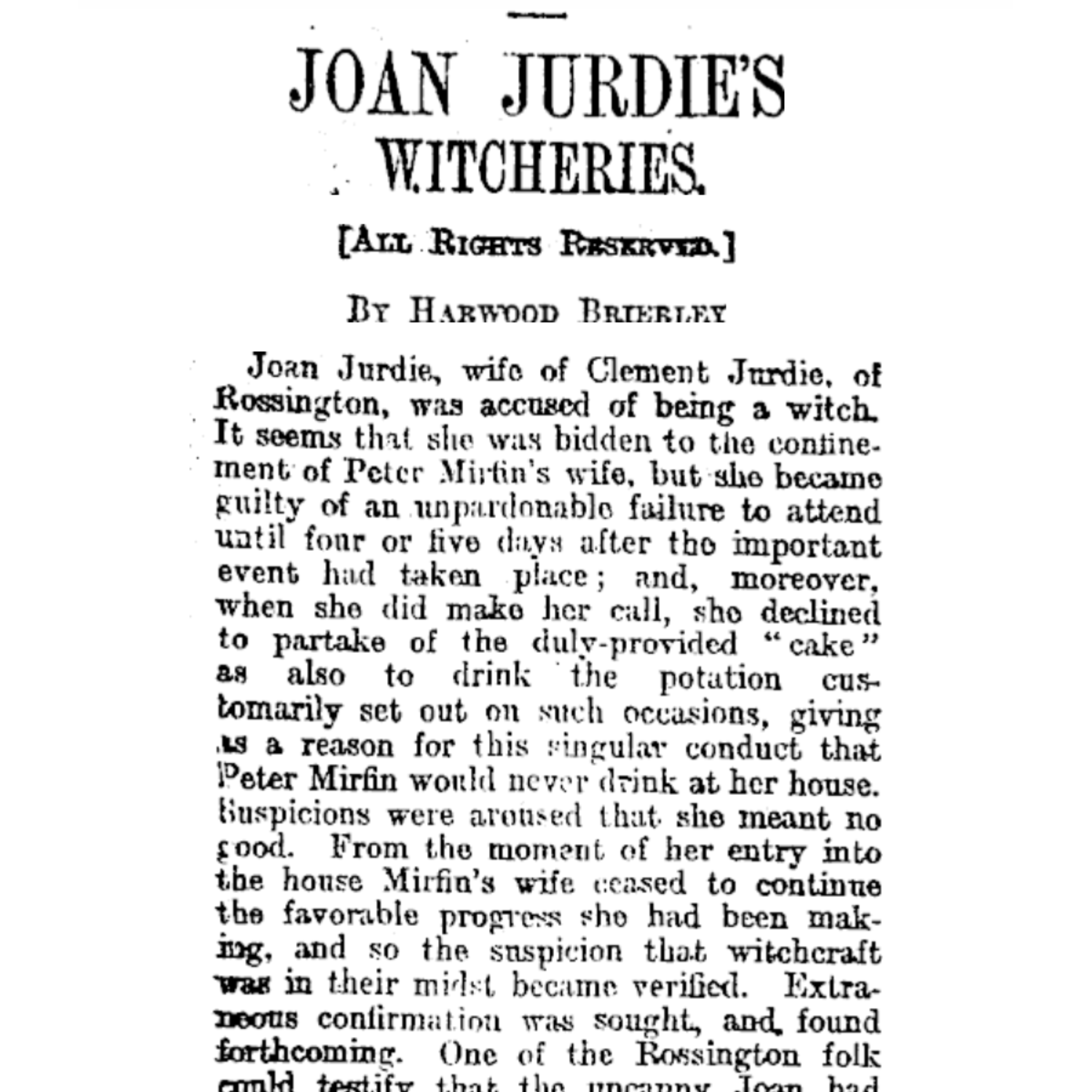
Evening Star, Issue 11385, 1 November 1900, Page 6
Anne Judd testified that Jennet had told her, only two nights before she passed away, that she was “ridden with a witch”, Katherine Dolphin came to visit and asked what she meant by that, to which Jennet replied: “woe worth her, she hath killed me, I mone never recover it. Weay worth her, I did well until Joan Jurdie wife came”.
Anne also told Hugh Childers that after the argument at the Mirfin house, she travelled over to Joan’s house and was met by Jane Trougheare, the household servant. After Jane politely asked after Anne’s sister’s health, Joan was heard interjecting with “abide her, she is not at the worst, she will be worse yett”. Granted, a little bit suspicious…
Katherine added to Anne’s testimony, stating that Jennet told her, “I was never well since Saturday that Jurdie wife was here, for the same night I was ridden with a witch, and therefore I could never eate any meate but supping meate [soup]”. Anne and Katherine really doubled down on this accusation, claiming that Joan was well-known for witchcraft within the community, which is an easy enough accusation in the 1600s as Joan was known for being skilled with medicine and was often asked after when someone had an ailment.
On 18th April 1605, Hugh Childers brought together a Grand Jury with Sir John Fearne, Recorder of Doncaster, and John Carlill, Alderman. This get-together was just to decide whether Joan’s crimes were enough to take to the Borough Sessions for a more formal trial. Front and centre at all hearings was Katherine Dolphin, surprise surprise, and she confirmed her allegations given to Hugh before the trial. But she didn’t stop there, Katherine really let Joan have it!
Katherine claimed that when Joan had helped her previously with her own child’s ailments, Joan had begged her to tell no one lest she be thought a witch. Katherine continued to recount a tale told her by Jane Spight (I think that’s called hearsay…) that she had asked Joan to help with an ill calf. Joan told Jane that the calf was not bewitched, which further convinced Katherine that Jurdie must be a witch “because she doth take upon her to helpe such thinges”. But she didn’t stop there!
Katherine then claimed that when she and her husband had met the Jurdies at a dinner party over at William Wainwright’s place in Doncaster, Joan had threatened Katherine because of her heavy involvement in the trail. Subsequently, one of their ox fell sick… followed by a steer …and then a cow. No one else’s livestock became sick, suspicious no?!
It was then Joan’s turn to appear before the Grand Jury. She had one plan, deny absolutely everything. Nope, she had no skill in medicine and no one called upon her to help the sick. No way did she claim to know Jennet was sick, and would only get sicker. Nuh huh, she did not threaten Katherine at the Wainwright house, not her.
Jane Trougheare, Joan’s servant, then took to the stage. She did claim that Joan, herself and Anne had discussed Jennet’s health, but claimed that Joan said “she was very sorie, but they weare not at the worst yett” but then went on to advise that “Anne take sage leaves and honie to rubb the childe’s mouth with all”. Of course, a completely different tone and intent than what Anne and Katherine had claimed.
They wrapped up proceedings, and Joan was not (at this time) referred to the Borough Sessions, however she was not off scot-free as the Grand Jury was reconvened six months later.
October 16th 1605, and finally Peter Mirfin was called to give his evidence. You know, the grieving husband? Who did not attend the first hearing? The jury was chaired by the new Mayor, Henry Riley, as Hugh had retired from Mayorship. Sir John Redfearne and John Carlyll did, however, return.
Peter had actually remarried in the interim to Jane Wildbore. Supposedly, Peter did not offer anything of value at this trial, he was all over the place and incredibly unreliable as a witness. He got the dates wrong, claiming his wife and child had died within two days after Joan’s visit, which did not match up with the evidence obtained by Anne or Katherine. Jane Spight, previously mentioned in Katherine’s testimony, did indeed let them know that Joan had told her that the calf was not bewitched, but its symptoms would return. And they did…
It was obvious that Joan was at least a ‘service witch’, a person with some herbal, midwifery and veterinary skills who would casually help members of her community. It seems that with her help came the accusations, one cannot simply help the community with such matters without have witchcraft floating around.
The hearings were so muddy that it was ruled as simply a quarrel between village women. Perhaps the Mayor saw the good that Joan had offered to the community and decided it wasn’t worthy of investigation. Great news, right? She did it, she defied the odds, the gossip, the accusations and walked away? Sigh…
1608, three years after this palaver, Joan was once more accused of witchcraft. And whomst, I hear you asking, accused her? Well, none other than Katherine Dolphin, again! She accused Joan of the deaths of three children who had all died over the summer of 1608. One being the child of Peter Mirfin and his new wife, the other two being Katherine’s own children.
Abraham de la Pryme wrote of the 1608 trial, “on the 10th April [she] feloniously practised witchcraft and sorcery upon Hester Dolphin, and on the 5th June, same year, upon Jane Dolphin, the daughter of William Dolphin; also, the like upon George Murfin, son of Peter Murfin on the 27th September following.”
It is unfortunate that infant mortality rates were extremely high in the 1600s. It’s fair to say that the heartbreak felt by the parents may have led them to find any reasonable explanation for such a loss, and it was unfortunate for Joan that her recent trial was still fresh in their minds.
The Grand Jury did, this time, push Joan to appear before the Doncaster Borough Sessions, given the severity of the accusations. There were no records of the outcome of this trial, it is a popular opinion that Joan must’ve been convicted the second time round and executed as such. However… there are Parish records of a ‘Joan wife Leonard Cherden’ from the 25th November 1629, which is over 20 years after her second trial, which could indicate she must’ve survived her second trial and went on to live as a free woman.
I like to think that Joan slipped the unfair arms of the 1600s justice system and continued her days untouched by those who had women murdered for very little. Long live Joan Jurdie!