Highwayman Higgins
Knutsford, Cheshire 1757
“Although not widely known outside Knutsford and Frenchay, more is told about Edward Higgins in local folklore and fiction than is readily available in factual documentation.” - Here Lies Higgins
A highwayman! I love tales of highwaymen, I must find some more for the Archive. Today we’re going to have a look at one of Cheshire’s own… Highwayman Higgins.
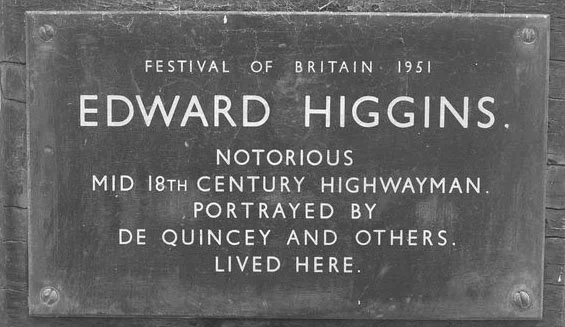
What we know about Edward Higgins comes mostly from local legend and fictional tales. Elizabeth Gaskell wrote The Squire’s Story, a short story based on Higgins’ time in Knutsford, and Raymond Foxall wrote the novel Squire Errant of which places Higgins in a more historically accurate, and well researched, setting.
Higgins’ story supposedly, according to legend, began when he was born in Cradley, Worcestershire, into an esteemed family, his father being the local squire. From the get-go, it seems Higgins was quite the troublemaker, it being rumoured that he ran off with the wife and valuables of a neighbour and being convicted of sheep and horse theft which would land him a sentence to transportation for seven years to the American colonies.
It’s believed that his transportation to America was paid for by his sister (who stole a large sum of money for Higgins just before his ship left the dock), meaning that Higgins did not have to be sold into indentured servitude upon arrival in America. Higgins then travelled to Boston, broke into a merchant’s house and stole another large sum of money to buy his passage back to England. It is said that Higgins spent some time in Manchester, before Parish records indicate that in 1757, Edward Higgins, described as a yeoman, married Catherine Birtles and settled in Knutsford.
Some would think that Higgins’ reputation as a thief and scoundrel would have earned him distaste from his new neighbours in Knutsford, but quite the opposite. Higgins rode with the local hunt, hosted soirées, and kept a fine home, earning him respect as a distinguished gentleman of the community.
But folklore insists that behind his polished manners, Higgins was a career highwayman whose “rent-collecting trips” were convenient covers for robbery.
The couple had several children while at Knutsford and supposedly rubbed shoulders with the local gentry, including Lord Egerton. Whilst keeping up the pretence of gentleman-ry, Higgins supposedly supported his family by thieving and periodically riding off to ‘collect rents’ from his tenants further afield. It is said that during his trips to ‘collect rent’, Higgins took part in many a robbery and many a murder.
Unfortunately for Higgins, his lust for robbery caught up with him, and he was eventually arrested for one of his burglaries in Knutsford in 1767.
He managed to escape and fled to Frenchay in Bristol, changing his name to George Hickson. Once more he portrayed himself as the gentleman, living with his wife and children, keeping a horse and dogs for hunting.
During his capture, with a hanging sentence, Higgins supposedly tried to forge his own pardon, but the deception failed. Higgins continued to make headlines after his execution by hanging in Camarthen in 1775, it is said that his body was removed from the gallows and taken down south, supposedly to be sold to a London surgeon to raise money for his wife and sister. It was reported that when the medical apprentice was about to begin work on the cadaver, Higgins allegedly came back to life and had to be executed for a second time!
There seems to be a lot of doubt surrounding the validity of the stories of Highwayman Higgins, many believed that he wasn’t a highwayman at all, just a lousy thief. But you must admit, he was most certainly as resourceful as a highwayman!