Roxburghshire, Scotland 16th Century
"every gentleman, by indefeasible privilege, kisses one of the ladies on entering the ruin.”
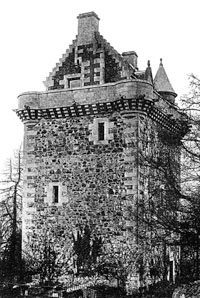
My eyes were immediately drawn to the name of this castle, and this has been the case for many folk, which unsurprisingly led to the legends and folklore tales that surround the naming of this Borders pele tower. But before we get to the juicy part, lets go over a little historical context for this magnificent structure.
Sitting atop the Minto Crags, two miles northeast of Denholm and one mile east of the village of Minto, this structure was founded by the Turnbulls of Barnhill and its purpose was to provide a stronghold for ‘Border Reiver’ Turnbull family. The structure was damaged during the 1545 raid on the Scottish Borders and then came into the possession of Sir Gilbert Elliot in 1705. His lucky descendants, the Earls of Minto, still own the property today. Sir Robert Lorimer heavily restored the castle in 1857 and it has been a shooting lodge and a private museum in its lifetime.
A bitesize chunk of history! Why on Earth is this tower named Fatlips Castle? There seems to be no definitive answer, but there’s many stories surrounding the name - I like to imagine every now and again some scoundrel comes up with a whole new tale of fiction, but that’s the fun of folklore!
One of the most notable of theories stems from the behaviour of the gentlemen visitors to Fatlips Castle. It was, supposedly, a known custom that any men that visit the castle must kiss one of the ladies before entering the tower, "every gentleman, by indefeasible privilege, kisses one of the ladies on entering the ruin.” Presumedly some gentlemen would visit more than others, those who love the ladies, forming ‘fat lips’ due to all the smooching they’d do.
Another story, a rather mean one I feel, states that in the early 18th century, the family had a child with Down Syndrome who lived locked away in the tower so that the families reputation could be maintained and visitors to the family home could not see the child. However, the name ‘Fatlips Castle’ appears on the Elliot family’s mid-18th century documents, it feels unlikely that the family themselves would have officially used this nickname if it was formed as a taunt.
A rather amusing tale has also been used to attribute the name to the castle. Supposedly, a goat lived on the grounds of the tower named Fatlips who would bleat loudly at the approach of the English, thusly alerting the Turnbulls of the approaching enemy. I find it fascinating, if true, that a goat would be able to differentiate between nationalities, but stranger things have happened!
To delve into the paranormal, as a lot of folklore tales do, the final theory on the naming of the castle comes from the name of a legendary spirit from Dryburgh Abbey in Berwickshire. A local vagabond woman, who would sleep in ruins such as Fatlips Castle, claimed that she only survived due to the kindness of ‘Fatlips’ (her name for the spirit of Dryburgh Abbey) providing her with food and water. She would claim that no matter which castle ruin she took shelter in, Fatlips would stamp the ground dry for her with his big iron boots. I’d like to think there’s still chivalrous spirits out there!
Despite there being no concrete reason for the nickname given to Fatlips Castle, the impressive tower has remained a beauty spot for many ramblers. I, for one, hope they never reveal the real reason for the naming of this tower!
Sources
https://fabulousnorth.com/fatlips-castle/
https://www.fatlipscastle.com/index.php/fatlips/fatlips-castle
https://turnbullclan.com/index.php/fatlips-castle
Chambers, Robert (1828). The Picture of Scotland I. William Tait. p. 328n.