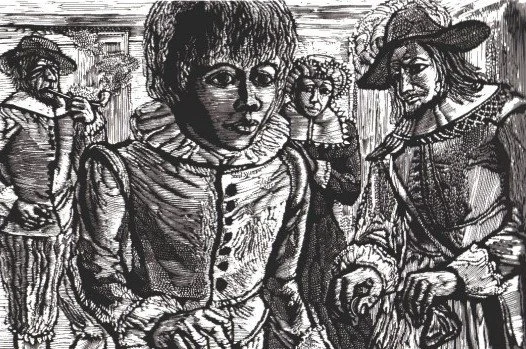
Calton Hill, Edinburgh 1684
“the woman which kept the house was of honest reputation among the neighbours, which made me give the more attention to what she told me one day about a fairy boy (as they called him), who lived about that town.”
Scotland seems to be the land of fairies. There’s so many tales of fairy-like beings, or those who communicate with fairies, which could be down to Scotland’s ancient Celtic roots (Celtic mythology often speaks of fairies, known as the Good Neighbours, being a central part of life). Perhaps it’s also due to the vast whimsical and dramatic landscapes, forests, glens, mounds, rock formations and lochs, fairies can often be described as protectors of nature, so it would be natural they’d show up in these wild areas.
One particular story, today’s folklore fable, involves a young boy from Leith who claimed to visit fairies every Thursday at midnight. Our protagonist for this story, as first recounted in Richard Bovet’s Pandaemonium or Devil’s Cloister in 1684, is Captain George Burton. Returning to Leith after a bought of sea travelling, Burton dropped in on his ‘friend’ (suspected mistress, in some recounts of the story) Maggie at his local hostelry. It was Maggie who told the tale of the Fairy Boy of Leith to Burton who would visit Calton Hill (which used to separate Leith and Edinburgh, but today sits in the centre of the city) and play drums to fairy-folk. Burton, indeed, was amazed and asked if he could meet with the boy - to which Maggie said she’d keep an eye out for him.
The next Thursday rolled by and Burton found himself walking past the hostelry when suddenly Maggie pointed out of the window, shouting ‘there he is, the fairy boy!’ at a group of boys playing on the street. Overjoyed, Burton approached the boy to throw as many questions as he could at the poor lad. The boy explained that every Thursday, at the turn of midnight (I’m presuming into Friday morning), he would play his drums ‘to a sort of people that used to meet under yonder hill’. Burton asked which people?! To which the boy replied:
“a great company both of men and women, and they are entertained with many sorts of musick, besides my drum; they have, besides, plenty of variety of meats and wine, and many times we are carried into France or Holland in a night, and return again, and whilst we are there we enjoy all the pleasures the country doth afford.”
Burton was baffled, how did he get inside the hill? And the boy, nonchalantly, described a huge pair of gates that would open for him, but were invisible to others without the fairy-sight. Burton, amazed, asked if the boy cared to dine with him and his friends that evening. The boy agreed, and showed up that evening to the hostelry. Burton, however, had a plan. He wanted to see what would happen if the Fairy Boy just so happened to miss his weekly drum performance for the fairies of Calton Hill, and so they fed him with rich food and supplied him with wine, hoping that it would make him forget. As 11pm approached, the boy had managed to evade them, slipping out onto the street. He was caught, and returned, but within a blink of an eye he was gone again.
Burton and his gang decided to follow the boy to Calton Hill, but not one street over they heard piercing screams, as if harm was befalling the Fairy Boy and, suddenly, he was no where to be seen. They searched high and low through the streets for the boy, but he had simply vanished. Many claim his disappearance was down to missing his appointment with Calton Hill, and falling victim to the wrath of the disappointed fairies.
Whilst the account of this story from Richard Bovet remains of an unknown validity, Scotiana makes a very interesting point relating to whether someone could ‘enter’ Calton Hill. The hill in question used to sit between Leith and Edinburgh, but as the city expanded it now sits in the centre of Edinburgh. It’s known that in the 1790s, there lived a Jewish merchant named Herman Lion in Edinburgh. Sometime in 1791, Herman started to look for a burial plot for himself, and not wanting to be buried in a Christian church, he asked the Town Council if he could use a little bit of land on Calton Hill. Two-hundred years passed, and the tomb of Herman was rediscovered, supposedly two men found a hole to climb through and ended up inside the tomb. They described the tomb as if it had once been a cave or a fissure in the land… Could the Fairy Boy have been describing this cave when telling people he could enter Calton Hill?
Sources
Scottish Fairy and Folk Tales: Fairy Tales: The Fairy Boy... | Internet Sacred Text Archive
The "Fairy Boy Of Leith" on Calton Hill, Edinburgh
The Story of the Little Fairy Boy of Leith -
Scottish Fairy and Folk Tales, by George Douglas, [1901], at sacred-texts.com
Pandæmonium, or the Devil's Cloister Opened, Richard Bovet. London, 1684.